
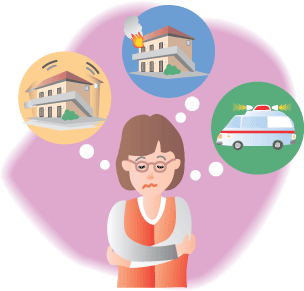
15-1 Earthquakes
(1) If you are at home…
Keep calm and protect yourself covering your head with futon. If you were using any sources of fire, turn them off when shaking calm down. If a fire starts, put it out with a fire extinguisher quickly and calmly. Actuate electric breaker.
- Ensure your safety first.
Fix furniture and home appliance that could not fall over or move around. - If you feel tremores, check all fire sources, extinguish all flames and close all gas taps. Turn off the breaker.
- Do not rush outside.
- Open windows and doors to secure an exit.
- Be careful for shattered glass.
Keep flashlight and slippers nearby for electric failure - Evacuate on foot
(2) If you are outside…
Beware of falling or collapsed objects. Be away from a concrete or stone wall, a cliff, and a riverside. Walk along a wide street. Evacuate to a safe building nearby to avoid falling glass shards if you are in inner city.
(3) If you are in an underground city…
Do not panic; cover yourself behind a wall or a post. Underground cities are resistant to earthquakes, but blackout or fire may cause chaos. Follow attendants’ instructions. You should reach an exit as long as you walk along a wall.
(4) If you are in a department store or a theater…
Do not rush to an exit. Follow attendants’ instructions and act calmly.
(5) If you are on a train or a bus…
Prepare against a crash halt. It may be dangerous to rush outside immediately from an emergency exit. Do not panic, follow crews’ instructions calmly.
(6) If you are in an elevator…
Hit all floors and get off at the nearest floor. If the elevator is caught between floors, call an emergency center using emergency telephone and wait for the rescue. The most important thing is to calm down.
(7) Preparations on a routine basis
- Participate in emergency drills to learn how to behave in an emergency.
- Hold family meetings on disaster prevention. Make sure the location of emergency supplies and check evacuation areas, sites and routes.
- Check and reinforce the earthquake-resistance of the building (e.g. posts, a foundation, roofing tiles).
- Reinforce concrete and stone walls to prevent from collapsing.
- Anchor furniture to prevent from falling down.
- Install a fire extinguisher.
- Have emergency supplies ready. Stockpile of food and drinking water.
- Install an earthquake-sensitive circuit breaker to prevent electrical fires.
(8) Disaster prevention activities of the city (town)
The city (town) establishes the disaster management office when a serious disaster breaks out or is predicted. The disaster management office is organized with the mayor as a general manager and municipal officers and volunteer firemen as staff. It works for emergency measure to secure citizens’ lives, property and safety.
[Inquiry]
- Fujimi-shi Kiki Kanri-ka : tel.049-251-2711
- Fujimino-shi Kiki-Kanri Bousai-ka : tel.049-262-9017
- Miyoshi-machi Jichi Anshin-ka Bousai Koutsu Anzen tanto :
tel.049-258-0019
15-2 Typhoons
At Japan Meteorological Agency homepage you can check a track of a typhoon and weather information.
You can access to a hazard map which forecast damage of natural hazard at the city government homepage. Check if your local area whether natural hazard is apt to occur.
Guerrilla rainstorm, or unexpectedly strong rain for the region often occurs recently. Check weather forecast or homepages in case of strong rain to guard yourself.
[Inquiry]
- Fujimi-shi Kiki Kanri-ka : tel.049-251-2711
- Fujimino-shi Kiki-Kanri Bousai-ka : tel.049-262-9017
- Miyoshi-machi Jichi Anshin-ka Bousai-Koutsu Anzen-tanto : tel.049-258-0019
[Homepage for information for disaster prevention]
- Japan Meteorological Agency homepage
https://www.jma.go.jp/jma/index.html - Ministry of Land, Infrastructure and Transport “Disaster prevention of river”
https://www.river.go.jp/index - “Disaster prevention information of river” in Saitama prefecture
https://suibo-river.pref.saitama.lg.jp/mainMap.html
[Hazard map]
- Hazard map of Fujimi-shi
https://www.city.fujimi.saitama.jp/anzen_anshin/08bousai/sonae/hazardmap/2010-0507-1628-137.html - Hazard map of Fujimino-shi
http://www.bosai-hm-fujimino.jp - Hazard map of Miyoshi-machi
https://www.town.saitama-miyoshi.lg.jp/bousai/bousai/2009-0710-1345-21.html
15-3 Foreign language broadcasts in an emergency
Information on damage and rescue is broadcasted in English when a disaster breaks out.
(1) Radio
Inter FM: 89.7 MHZ
(2) TV
NHK main channel 1 (the second sound channel), NHK’s satellite broadcasting 1 & 2 (the second sound channel)
15-4 Fires & medical emergencies
(1) For fires, rescue or ambulance, dial 119
Yell for help when a fire breaks out. In the case of house fire, fire extinguisher works if fire has not reached the ceiling. However, if you feel danger, do not attempt too much and evacuate immediately. Keep your head down in smoke.
(2) Fire extinguisher
There are several types of fire extinguisher (e.g. dry chemical, pressurized water, foam). Different types have different usage methods and expiration dates. Know how to use your extinguisher correctly and check it regularly.
(3) Emergency contact system
In the event of an injury, sudden ilness, or fire, equipment can be rented to the fire department immediately. The target is a household with only the elderly or disabled, who has a chronic illness. For details please consult the office.
[Inquiry]
- Fujimi-shi Kourei sha Fukushi-ka : tel.049-252-7108 (direct line)
- Fujimino-shi Kourei Fukushi-ka Chiki Shien-kakari : tel.049-262-9038
- Miyoshi-machi Yakuba Fukushi-ka : tel.049-258-0019 (extension 176)
(4) NET119 emergency call system
The Iruma Eastern District Administrative Association operates the NET119 emergency call system for those who have difficulty making a 119 call by voice.
The system uses the web (Internet) function of smartphones and mobile phones to make a 119 call with simple screen operations.
User registration application is necessary for the use.
[Inquiry]
Iruma Eastern district Administrative Association Fire Department Headquarters, Commands and Control Division
- E-mail : sirei-01@irumatohbu119.jp
- TEL : 049-261-6031
- FAX : 049-262-2633
(5) e-mail and fax 110
Saitama prefectural police headquarter provides 「FAX 110」 and 「E-mail 110」 for hearing-impaired and speaking-impaired person to call police station when he/she happened to meet an accident or trouble.
Reporting system of E-mail 110 is connecting to private homepage and reporting by chatting.
- E-mail 110 Address for reporting : https//saitama110.jp/
- FAX 110 : 0120-264-110
15-5 Ambulance
Dial 119 to call an ambulance in case of medical emergencies such as a sudden illness or a serious injury. Ambulance service is free of charge. To secure ambulances for emergency, please use your own car or taxi in the case of a minor injury.
(1) Necessary information to ask for ambulance service
- Where the patient is
- Your name and telephone number
- Landmarks around you
- Condition of the patient
(2) How to call 119
When reporting a fire or emergency, speak calmly and clearly about the type of fire or emergency and the address or location.
- Fire: Kaji desu
- Medical emergencies: Kyukyu desu
- Please send an ambulance: Kyukyusha wo onegai shimasu
15-6 Actions in case of missiles flying to Japan
Gather essential information during disasters.
If missiles are about to hit Japan possibly, a special siren sounds in addition to emergency warning system (radio and TV broadcasts in Japanese) utilizing Japan’s satellite-based disaster warning system. Emergency alert email is sent to persons in a specific area at the same time.
In case you received emergency information, take action immediately.
When you are outdoors
- Go into a nearby building (a substantial concrete building if possible)
- If you can’t find a building nearby, take cover or lie flat on the ground.
When you are indoors
- Stay away from windows or move to a room without windows.
Civil Protection Portal Site (English)
https://www.kokuminhogo.go.jp/en/pc-index_e.html
Safety Tips: Disaster Information App for Foreign Residents
https://www.jnto.go.jp/safety-tips/eng/app.html